A practical comparison for executive leaders in healthcare, government, non-profit, and insurance organizations
The Choice Every Leader Faces on a Major Project
When an organization launches a CRM upgrade, system replacement, or complex digital initiative, two leadership environments produce dramatically different outcomes.
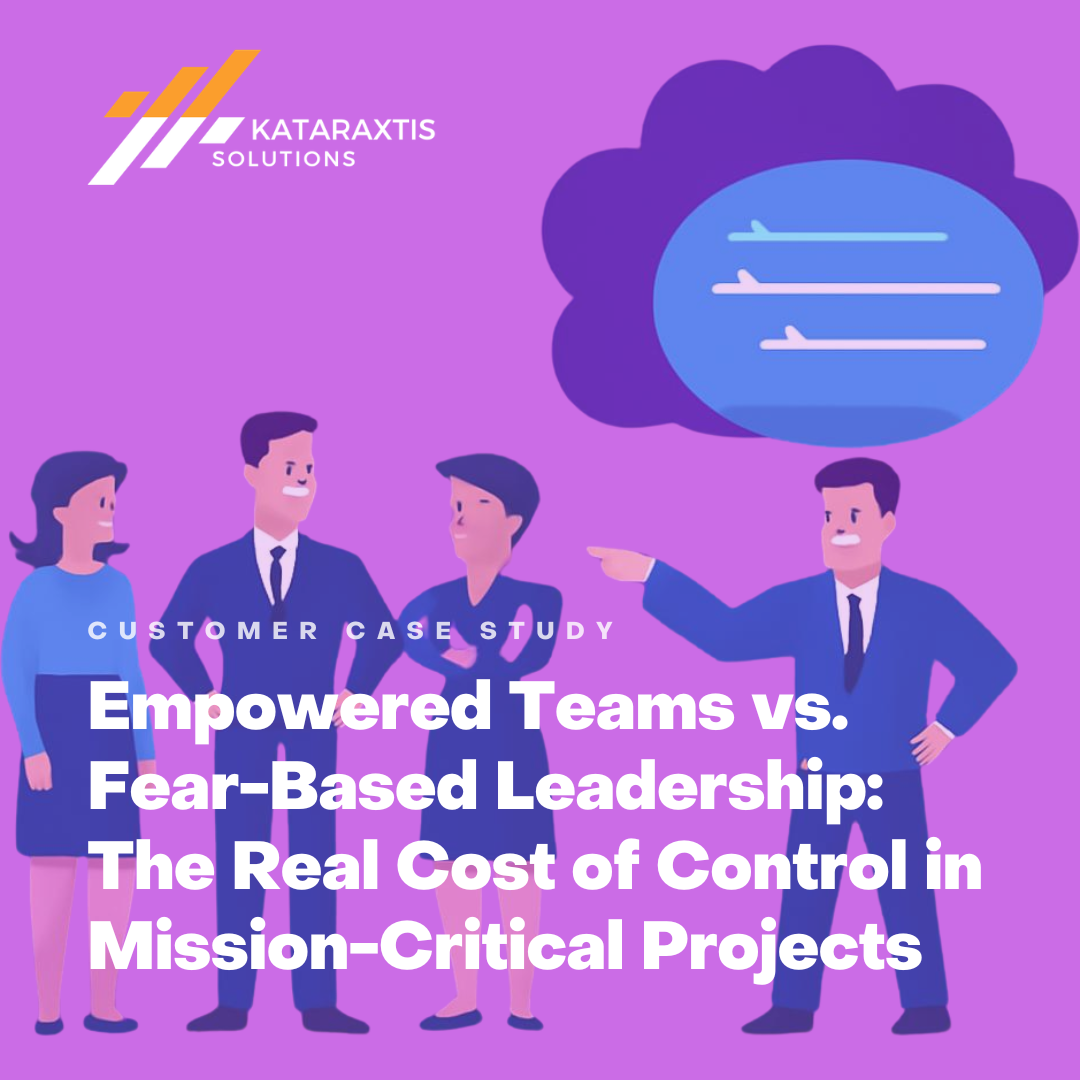
In an empowered environment, stakeholders own decisions, surface incomplete knowledge early, evaluate results honestly, work together as a team and stay engaged. External consultants can challenge assumptions without being labeled “high conflict”. The project moves quickly. Problems are solved efficiently. The Organization ultimately receives a well debated, efficient software solution with a high adoption rate and long term scalability.
In a fear-based environment, staff refuse to make decisions even when appointed as decision makers, avoid meetings where the leader is not present, withhold business-process knowledge (making requirements elicitation nearly impossible), and decline to comment on the effectiveness or ROI of features built at the leader’s request. Consultants who push for clarity are scolded or quickly removed. Knowledge walks out the door. The project stalls, and with each blocked requirement, and replaced consultant, the risk of project failure increases exponentially. These projects move slowly, encounter lots of errors, complex requirements get forced into the project due to lack of debate, cost and scope creep out of control with change requests, and often the software ends up no better than what the organization has now, resulting in poor adoption with a huge impact on long-term scalability.
This is not theory. It is the pattern repeatedly observed in organizations that have already failed once and are attempting to restart under the same leadership style.
What the Research Shows
Google’s Project Aristotle, which studied 180 teams, found that psychological safety—the shared belief that it is safe to take interpersonal risks—was the single most important factor distinguishing high-performing teams from the rest. Who was on the team mattered less than whether people felt safe to speak up, admit mistakes, or offer ideas without fear of embarrassment or punishment.
Amy Edmondson, who first defined the concept, describes it as “a shared belief held by members of a team that the team is safe for interpersonal risk-taking.” Teams with high psychological safety report more errors early (when they are cheaper to fix), generate more innovative ideas, collaborate more effectively, and deliver better results.
By contrast, fear-based or toxic leadership produces the opposite behaviors: silence, defensive reporting, decision paralysis, and elevated turnover. Studies link these environments to higher project failure rates, manipulated status reporting, and significant productivity losses. One analysis estimated that fear-based leadership costs the U.S. economy tens of billions annually in lost productivity. Research on toxic leaders has found average organizational costs running many times the leader’s own compensation when turnover, absenteeism, reduced innovation, and rework are included.
In high-stakes sectors—healthcare, government, insurance, and non-profits—these costs compound. Delayed or failed systems affect patient care, citizen services, claims processing, compliance, and mission delivery. Leaders in these environments are visible. When a high-profile project fails a second time, the leadership style that blocked decisions and drove out expertise rarely escapes scrutiny.
Organizational Impact and Cost
Fear-based workplaces typically produce:
- Incomplete or inaccurate requirements because process knowledge is withheld.
- Decision latency that turns the leader into the single point of failure.
- Suppressed risk reporting until problems become crises.
- Rapid consultant turnover: experienced practitioners leave after being scolded or are terminated for being “high conflict” when the real source of friction is the leader’s intolerance of challenge.
- Loss of institutional knowledge and repeated onboarding costs on restart attempts.
- Inability to measure or improve the ROI of features the leader directed.

Empowered environments produce the reverse: faster decision cycles, earlier problem detection, retained expertise (both internal and external), honest post-implementation evaluation, and higher likelihood of on-time, on-value delivery.
The financial and reputational difference is substantial. Replacement costs for departing talent, extended project timelines, rework, and the opportunity cost of delayed capability all accumulate. In regulated or publicly accountable organizations, the visibility of failure adds further career risk for the responsible executive.
The Personal Risk for Fear-Based Leaders
An upgrade or major system project is often the moment of highest personal exposure. Sponsors, boards, and oversight bodies notice when the same patterns that caused a prior failure reappear: stakeholders who will not decide, consultants who cycle out, and a project that remains blocked by the need for constant leader approval.
Leaders who maintain a fear-based style during these initiatives increase the probability that the project fails—and that the failure is linked to their leadership. In healthcare, government, insurance, and non-profit settings, that linkage can end careers.
The alternative is not to abandon accountability. It is to treat the project as a controlled experiment in empowerment: deliberately transfer decision rights to named stakeholders, publicly support those decisions, create forums where incomplete knowledge can be shared without personal risk, and treat honest evaluation of outcomes (including leader-requested features) as essential. These steps can be introduced incrementally and measured.
Why Some Consultants Still Deliver
Most consultants trade project success for likeability. Faced with fear-based resistance—stakeholders paralyzed by indecision, leaders defensive to a fault, or subtle efforts to sideline the outsider asking hard questions—they back down or blend in, to the detriment of the project.
A rare breed of practitioners operates differently. Instead of dodging friction, they absorb it, creating a protective buffer where teams can contribute without risking their necks. Armed with unvarnished candor, they drag hidden process gaps, capacity limits, and decision bottlenecks into the light. As strategist Susan Schramm urges leaders to ask: “What if they’re right?”
Rather than viewing pushback as obstruction, these consultants treat it as protective intelligence—vital data that must surface before it goes underground and derails the project. They tell executive leadership the unvarnished truth about why decision rights need untangling and why systemic efficiency is non-negotiable.
The stakes of cutting the consultants who “pushback” are entirely predictable: the protective bubble bursts, stakeholders retreat into silence, institutional knowledge vanishes, and the initiative spirals right back into the dysfunction that triggered the hire in the first place. For these consultants, delivery always trumps popularity.
For executives accountable for results in high-stakes environments, recognizing that distinction is the ultimate dividing line between a stalled initiative and a successful finish.
The Practical Question
If your organization is preparing a CRM upgrade or similar complex initiative, ask:
- Do appointed stakeholders actually make decisions, or do they wait for you?
- Do people share real process knowledge, or are requirements incomplete?
- Do external consultants stay and contribute, or do they cycle out after experiencing friction?
- Can the effectiveness of leader-directed features be evaluated honestly?
If the answers point to fear-based patterns, the project is already at elevated risk. An upgrade is not the time to tighten control further. It is the time to test a more open style—or to engage support capable of driving progress even when the culture resists.
The research is clear. Empowered teams outperform. Fear-based environments raise the probability of failure. And in mission-driven, highly visible sectors, that failure can become the leader’s personal liability.
The choice remains with the executive who owns the outcome.